Tuesday, 17 April 2012

What the experts are saying: Council for British Archaeology

The Council for British Archaeology issued the following press release on 13th April; it was picked up by the Newshopper (see previous post). We look forward to seeing its contents reported in other publications.

CBA forms expert panel for Deptford Dockyard

The Council for British Archaeology has convened a panel of independent experts to discuss an alternative future for the former site of England’s first Royal Dockyard at Deptford, founded by Henry VIII in 1513.

Calling on the expertise of the Naval Dockyards Society, the Garden History Society, the Panel for Historic Engineering Works and the London and Middlesex Archaeological Society, the CBA are hoping to inform a better, heritage-led scheme that delivers wider public benefit and a more sophisticated approach to this internationally important site – one that served this country for nearly 400 years, harboured the Mary Rose and saw the knighting of Sir Francis Drake on the Golden Hind.

Lewisham Council have sent back the planning application for Convoy’s Wharf, which is for over 3,500 new homes, for revisions, claiming rightly that, it was not sensitive enough to unique heritage assets of the dockyard. As a consequence, the developers, Hutchinson Whampoa, have called in Sir Terry Farrell to look at redrawing the masterplan. Meanwhile, DCMS have asked English Heritage to look again at the heritage status of the site, which along with the adjacent Sayes Court Garden currently has no overall designation.

Working with local group Deptford Is, the CBA and its expert panel are looking to assist the developers and English Heritage in their understanding and enhancement of the dockyard and its remarkable history. There is immense potential here, for a scheme to be delivered that benefits the local community, in our Olympic year and with the 500th anniversary of the founding of the site to follow in 2013, surely our first Royal dockyard deserves both protection and respect.
The dockyard at Deptford was founded by Henry VII IN 1513 to build vessels for the Royal Navy. As the dockyard closest to the Navy Board, Deptford grew to be the most important of all the royal dockyards, at its height it was known as the ‘Cradle of the Navy’ and the docks, slipways and wharves constituted 600 feet of river frontage. Buildings that survive on site include the Master Shipwright’s House of 1708, the first purpose-built dockyard offices of 1720 and Victorian slipway covers of 1846. However, what survive below the ground is more impressive. The Great Dock, slipways, mast ponds and the huge basin, along with Sayes Court Garden, constitute an enormous site – one that has had a pivotal role in England’s history.

Other facts -

 - Elizabeth 1 knights Sir Francis Drake aboard the Golden Hind at Deptford in 1581
 - HMS Bounty re-fitted in 1787
 - The rebuilding of Cook’s Endeavour in 1768
 - Several of the warships that served under Nelson at Trafalgar, designed and built at Deptford


Sayes Court Gardens, which was a key site in the formation of the National Trust, was the creation of Seventeenth century diarist, John Evelyn. Made up of an elaborate parterre, long avenues and a great orchard of three-hundred fruit trees, a lake with an island and a large grove of trees of many different species the garden was tremendously influential at the time. Now, unfortunately, it is now almost completely buried under concrete. The Garden History Society has a study day at the site on the 25th April and has recently stated: “The influence of the garden at Sayes Court on garden design and development in England in the 17th century is well documented and its location beside Deptford Docks was fundamental to John Evelyn's science of experimentation with new plants"


The Council for British Archaeology was established in 1944 and is the national amenity society concerned with protection of the archaeological interest in heritage assets. Heritage assets with archaeological interest are the primary source of evidence about the substance and evolution of places and the people and cultures that made them. Local authorities have a duty to notify the CBA of applications for listed building consent involving partial or total demolition.


Deptford Is.. are "a group of local residents who want to ensure that the redeveloped Convoys Wharf offers the best for Deptford and its future". They have proposed a number of alternative projects for the site; a recent consultation allowed them and other local groups to give their visions of the site. A report on the event can be found here.

Hutchison Whampoa Properties and its architect Aedas has submitted an application for more than 3,000 new homes, with a range of tenures, new public squares and the opening of Deptford's Riverside, details of which can be found here.

Deptford is...in the news again


The News Shopper has reported on the Council for British Archaeology's support for our proposals, and has also stated that English Heritage has been requested to re-examine the status of the site by the Department for Culture, Media & Sport.


ALTERNATIVES to a controversial £1bn high-rise development at a former royal dockyard will be put forward by archaeology experts.

The Council for British Archaeology has convened a panel of independent experts to discuss Convoys Wharf in Deptford, saying the current plans do not respect its history.

Deptford's dockyard was founded by Henry VIII in 1513 as the first royal dockyard, later harbouring the Mary Rose and the Golden Hind when Sir Francis Drake was knighted.

The panel will work with a group of concerned people in the area who have formed the Deptford Is campaign group.

Hutchinson Whampoa's application for 3,500 new homes at the site is currently undergoing revisions with the help of top British architect Sir Terry Farrell.

And the Department for Culture, Media and Sport has requested English Heritage re-examine the site's status, particularly Sayes Court Garden - created by 17th century diarist John Evelyn.

Sunday, 15 April 2012

Convoys archaeology on satellite mapping

Despite a time lag of six months or more, the first aerial views of the excavations at Convoys Wharf have appeared on Bing maps.

The status of the excavations on the aerial view, shown below, suggests it dates from about the time of the first public archaeological tours of the site last October.

Copyright: Bing Maps


Below you can see a picture of part of the 1774 Deptford Dockyard model, which has been annotated to show the locations of the docks and buildings that are revealed in the satellite photo. (Click on either of these photos to make them bigger and read the annotation).

With this photo and the evidence we have seen in more recent excavations - plus of course the many areas of the site that have not yet been fully excavated, including the double dry dock, it is clear that the extent of archaeology on the site is immense, and the case for proper listing and protection of the dockyard structures is overwhelming.
Copyright: National Maritime Museum

Sunday, 25 March 2012

Open day at Convoys Wharf

The Convoys Wharf community consultation day attracted a large number of people from the local area and beyond, with tours of the site and presentations from local community groups.

It was fascinating to see how much of the original docks are still there, only just below the surface of the ground. Many of the stone and brick structures seem to be in pretty good condition where they have not been damaged by later construction, although the archaeologist Duncan Hawkins, whose company CgMs is working for developer Hutchison Whampoa, would not be drawn on the structural soundness or otherwise of the dock walls.

The turnout was impressive, and quite a few people were unable to find seats in the marquee, which had been set up with tables and chairs, but still remained standing throughout the presentations, demonstrating that they were keen to hear about the alternatives.

The head of the European arm of developer Hutchison Whampoa, Edmund Ho (below), welcomed everyone to the event during the introductions, along with Joan Ruddock, who attended the launch of our alternative vision last year, and declared herself to be in full support of our plans. 


Deptford Is.. member William Richards (below) introduced the three projects that we are proposing, and urged the audience to consider the future of the site very carefully.

"It must be said that anyone here should count themselves as crazy if they were to resist inevitable and necessary regeneration of this site, which has the assets of place, location, scale and heritage to make it remarkable in London.
"It is with a desire to achieve that the community offers its ideas. Some of the specific ideas are relatively new, some are the result of ten years of actively engaging with and researching the site; all the ideas are almost beyond imagination - but the challenge for everyone in this room is to elevate the future of the site beyond the banal, beyond the expedient and reflect the values of the site into the future. It must be excellent.
"It must work, for those who live here today and for those who will come to Deptford in the future."

William introduced other members of the group to talk about our three proposals - the Lenox project, Sayes Court Gardens, and the Seven Bridges, all of which were also presented at our alternative vision launch last year.


Other presentations included inspiring contributions from members of the Second Wave Youth Arts group in Deptford, who urged the planners to consult and engage with the young people of the area. It was not simply a plea to be consulted, it was a confident statement that the young people of Deptford have a lot to offer that the masterplanners can benefit from.


Architect Sir Terry Farrell, whose firm has been employed by Hutchison Whampoa to review the masterplan for the site, rounded off proceedings by explaining that he and his team would go away and consider all the comments and ideas, before starting on the next phase of the consultation process which would inform the masterplan review.


The Deptford Dame has also published a report on the event, which you can read here.

Sunday, 18 March 2012

Come to the community consultation day!

The community consultation day which is being hosted by developer Hutchison Whampoa on Saturday 24 March is probably the best opportunity yet to make the strength of feeling in the local community heard by those responsible for the masterplan.

With its existing masterplan attracting strong criticism for riding roughshod over the significant heritage of site, Hutchison Whampoa has asked Sir Terry Farrell's practice to consult with the local community before carrying out a review of the masterplan. He will be attending the open day on Saturday, at which there will be short presentations about some of the ideas being put forward by local groups, including Deptford Is and its proposals.

If you want to show your support for these ideas, in front of the people who have the power to make them happen, you should make every effort to attend. There will also be the opportunity to ask questions of the developers, the architects and the local groups. To take part in the presentations and question-and-answer sessions you must arrive promptly by noon.

You can also join a tour of the site and see the archaeological dig which is underway - tours are either at 11.15am or at 2.15pm and take about an hour.

Full details are listed below - the event will take place on the Convoys Wharf site:


11.00 Exhibition opens

11.15 – 12.15 Site and archaeological tour opportunity 1


12.15 –14.15
Welcome from Hutchison Whampoa, followed by speeches and presentations, including Joan Ruddock MP, Sir Terry Farrell and colleagues, and local community groups.

The presentations will be followed by question and answer opportunities and refreshments will be provided during the two-hour period.

PLEASE NOTE: If you want to take a full part in these sessions, please arrive promptly at noon. Register for one of the site tours on arrival.

14.15-15.15: Site and archaeological tour opportunity 2
16.00 Exhibition closes

You must bring appropriate footwear and clothing for the site tour, bearing in mind that the site can be dusty and muddy depending on the weather.

For further information and to confirm attendance please call 0845 460 6011 or email info@convoyswharf.com

Saturday, 10 March 2012

New date for community consultation event

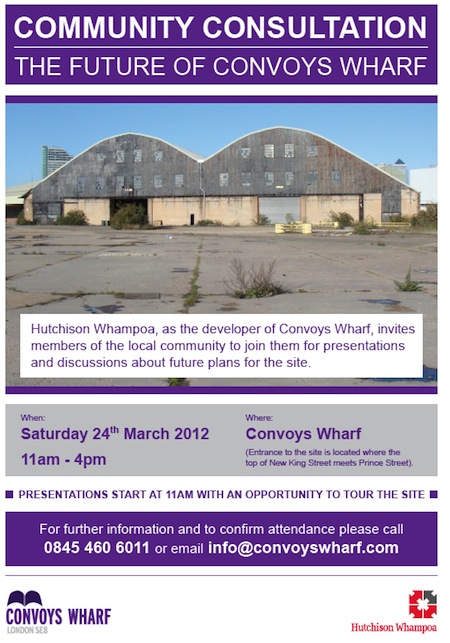
Hutchison Whampoa, the developer of Convoys Wharf, has invited members of the local community to attend an open day on Saturday 24th March from 11am to 4pm.


The event is slated as 'presentations and discussions about future plans for the site'.

The poster says that the presenations start at 11am and there will be an opportunity to tour the site. You should meet at the entrance to Convoys Wharf, which is at the top of New King Street.

According to the poster you should email info@convoyswharf.com to confirm attendance, or call 0845 460 6011.

Sunday, 4 March 2012

The significance of Deptford's dockyard basin

Museum of London Archaeology has published brief information on its website about the continuing excavations at Convoys Wharf. The latest post focuses on the Dockyard Basin, one of the most important below-ground structures on the site which lacks any kind of statutory protection.

MOLA says:

"The excavations... have unearthed several phases of the Dockyard Basin. This large pool probably began as a natural pond at the confluence of the River Thames with the small stream identified earlier in the excavation. Historical sources suggest that the basin was adapted to moor several of the King’s ships in the early 16th century and later used to season masts. By 1688, the Dockyard Basin (or ‘Wett Dock’) was hexagonal in plan, with slipways on the west side and a canal connecting it to the river. Once the ships were largely complete, they were launched into the basin to be fitted out.

"Excavations have identified a timber revetment wall that probably dates to the 18th century when the basin was remodelled. The revetment was held in place by large horizontal timber beams, called land ties, on the landward side.

(copyright MOLA)
The east wall to the canal linking the basin to the river, built in 1814 to John Rennie’s design. The recess to the right of the depth gauge would have housed an iron and timber gate. The wall replaced an earlier timber version, seen in the background of the image.

"The early 19th century saw a dramatic increase in the size of warships and the four slipways at the edge of the basin shown in the c1774 model had been replaced by two much larger stone slips by 1868. These stone slipways were protected from the weather by an open-sided cover building, now known as the Olympia building (listed Grade II). The cover building is one of only two structures visible above ground that date to the Dockyard period (the other being the Shipwright’s House outside the boundary of the site).

(copyright MOLA)
The same canal wall looking west from the landwards side; this side of the wall would not have been visible when the basin was in use as it was below ground level.

"The excavation has revealed the evidence for two phases of canal walls linking the basin with the river. The later phase, built in brick and stone in 1814 to a design by John Rennie, is shown in the first of these images with the earlier timber version, just beyond, to the east. Depth gauges were identified in both phases of walls – Roman numerals cut out of copper plate and nailed to the timber wall and carved into stone in the later phase."

But the extent of the excavations being carried out on this enormous site, which has huge significance for the nation's maritime heritage, are woefully inadequate. While the condition of the underground structures that have been uncovered has been found to be variable, it is impossible to state conclusively – as developer Hutchison Whampoa is doing – that these heritage structures cannot be saved. Only a tiny percentage of the dockyard has been excavated, yet the developer is dismissing any suggestion that these major structures be incorporated into the masterplan, instead proposing 'preservation in situ' which essentially means that no foundations will theoretically be allowed to damage the remains, but they will still be buried below a permanent building.

The current masterplan for Convoys Wharf completely disregards English Heritage guidelines on maritime & naval buildings (2011), which highlight works by John Rennie as worthy of a high grade of protection and describe sites such as the basin, basin slipways, basin slipway covers and caisson gate infrastructure as 'sites of collaborative genius'.

In the case of Convoys Wharf, these below-ground structures are all works by eminent Georgian and early Victorian engineers.


Deptford was the first of the royal naval dockyards to have a wet dock or basin and this technology was exported to outlying dockyards such as Chatham in about 1650. Under the administration of Sir George Carteret, Deptford's skilled workmen and naval dockyard officers built the wet dock at Chatham.

The basin is also where John Evelyn carried out the first diving bell experiments, where Cook hoisted the pennant on board the Endeavour in 1768, where Bentham built the dry dock in 1802 with Edward Holl, where in 1814 John Rennie rebuilt the basin entrance with the latest caisson gate technology, where Capt. Sir William Denison built the slipways to the basin with slipway covers built by George Baker &Sons, where George Biddel Airey tested the effect of a ship's magnetism on navigation instruments, and from where in WWI and WWII, supplies were sent out to troops stationed around the world.

The developer's design team has also ignored English Heritage London area committee comments from 2003 and 2005 which requested that the Olympia building be visible from the river. Hutchison Whampoa has dispensed with the Richard Rogers proposal, which was to create a public plaza on the site of the basin – the current masterplan all but cuts the Olympia building off from the river, preventing the building and its importance to the site and the former dockyard from being properly understood, and making a mockery of PPS5 guidelines on planning for the historic environment.