Mark Laird is Senior Lecturer in the History of Landscape Architecture at Harvard University and the foremost authority on John Evelyn. He has recently written to the Mayor of London from Harvard Design School with respect to the Convoys Wharf application and in support of the proposals from Sayes Court Garden CIC:
"It is impossible to overstate the significance of Sayes Court and the history of John Evelyn's life and work at the site that is under threat of irreversible development. Over the past twenty years, I have written three scholarly articles on Evelyn at Sayes Court. My forthcoming book, A Natural History of English Gardening (Yales University Press, Spring 2015) will open with a chapter on his significance as horticultural and technological innovator and as environmental policy maker. His Fumifugium (1661), Sylva (1664) and Acetaria (1699) laid the groundwork for a sustainable London of the 21st century – clear air, tree canopy, and food in the city.
"The Greater London Authority has shown leadership through policy documents (from London Biodiversity Action Plan and East London Green Grid Plan to the March 2012 report, London World Heritage Sites – Guidance on Settings). These documents are in line with the new UNESCO Recommendation on Historic Urban Landscape (HUL, November 2011), which seeks to integrate 'policies and practices of conservation in the built environment into the wider goals of urban development'. In the Foreword to the March 2012 GLA document, Boris Johnson reiterates the importance of London's built and natural heritage in benefiting 'our economy, culture and quality of life'. Sayes Court is the test case for his claim: 'How we manage this dynamic juxtaposition in ways that respect the past, while welcoming the future, will be a mark of our success in maintaining London as a really world class city'.
"The arguments in the 'Sayes Court Garden Programme and Analysis' report (February 2014) – and especially the modifications to P16 proposed in the 26 February 2014 statement – are built on very solid foundations. As you are aware, the Sayes Court Garden website features my own reconstructions of Evelyns's parterre and grove, which, until the better winter of 1683/4, lay immediately adjacent to his manor house. The archeaological site plan of Stuart Structures may look insignificant, yet the trace of the garden wall on the west side of the important vestiges of the manor house and the trace of the dockyard perimeter wall on the east side are absolutely critical to what I have reconstructed. The proposed P16 block would forever destroy and cover over these traces and vestiges and obliterate the core of Sayes Court – the manor house that was the intellectual home of Evelyn's environmental vision.
"Creating, by the modifications to P16, a new Centre for Urban Horticulture on the archaeological site of the manor house is precisely the accommodation of the old within the new that the Mayor sees as a measure of success and that UNESCO would deem a model for Historic Urban Landscape. The Centre would join other models of 'best practice' from around the world. Using the Evelyn cabinet of curiosity as a starting point for a modular and flexible layout of the garden spaces would unify the geometries of the blocks with the geometries of urban horticulture and forestry, mediciinal gardening, beekeeping and fruit growning, and greening technologies. The opportunity for local communities to benefit from learning about health and nutrition with environmental education at the primary school level makes Evelyn's teachings relevant now and for the future.
"The Royal Horticultural Society and the National Trust have both identified an acute skills shortage in areas that Evelyn would have understood when writing his Directions for the Gardiner at Says-Court in the mid-1680s. A Centre for Urban Horticulture, while training a new generation of local youth as skilled gardeners, could also become a centre of excellence in the fields of landscape urbanism and ecosystems performance. It could advance natural and cultural heritage studies in cooperation with the World Monuments Fund, English Heritage, National Trust, the Council for British Archaeology and the Garden History Society. In this vision for the Centre, the four pillars of sustainable development identified in the UNESCO statements on HUL – economy, ecology, community and cultural resources – are integrated in an appropriately holistic way: [HUL] seeks to increase the sustainability of planning and design interventions by taking into account the existing built [and natural] environment, intangible heritage, cultural diversity, socio-economic and environmental factors along with local community values'.
"The international community of scholars and practitioners is watching the debate over Convoys Wharf and Sayes Court with great interest and some anxiety. Will the GLA's guidance in the debate feature positively in textbooks to come as it has in the past in books devoted to biodiversity and climate-change planning? I, for one, am putting my faith in the Mayor and the GLA to reach the only right decision."

Showing posts with label consultation. Show all posts
Showing posts with label consultation. Show all posts
Saturday, 22 March 2014

Tuesday, 25 February 2014
Developer claims of 'significant concessions' on Convoys masterplan questioned by Deptford Is..
An article in Building Design last week had Convoys Wharf developer Hutchison Whampoa claiming to have made 'significant' concessions in its masterplan following a recent meeting with the GLA.
The article, which noted that the determination of the application by the Mayor of London was now delayed according to the original schedule, said:
“We have made further revisions to our masterplan to address issues raised by local groups,” a spokesman for the developer said. “By moving the school, creating new space for a John Evelyn horticultural centre, lowering the height of a building on the boundary adjacent to the listed Shipwright’s House and offering the wharf site for the Lenox project, we have made significant concessions.”
Unfortunately the developer's definition of 'significant' is at odds with our own understanding of the word, and the changes that have been made are either minimal, or in the case of the Lenox project, non-existent. None of the amendments are sufficient to offer real hope or properly support the long-term viability of either of the community-led schemes.
In truth, the situation for the Lenox project, despite Hutchison Whampoa's claim, is unchanged from the first public viewing of Farrell's revised masterplan. At the first public consultation in July 2012, a large ground-level model of the proposed redevelopment incorporated a model of a wooden ship on the protected wharf area. The model was labelled 'The Lenox Project'.
A verbal offer that the Lenox could occupy the protected wharf for '5-7 years' and then depart to somewhere else is still the only indication from Hutchison Whampoa that they have made any attempt to even consider this fantastic project. But as its promoters have made clear numerous times, a temporary presence on the site is entirely contrary to the central ethos of The Lenox Project vision.
Using the Olympia building for the Lenox would not only offer a tangible link to the history of this listed structure, it would provide a long-term future for the building at the heart of the site.

Although Sayes Court Garden CIC has persuaded the developer to make some adaptations to its masterplan, the implications of these changes for the developer are minimal and have been accommodated with no loss of floor space.
But in order for the educational aims of the proposed John Evelyn Urban Horticulture Centre to be achievable, further changes are required, in particular relocating the centre to a stand-alone building located on the site of the former Sayes Court manor house.

This stance is strongly supported by the National Trust and The Garden History Society. But although Sayes Court Garden CIC has demonstrated how such a change could be accommodated without compromising the developer's return or making significant changes to the masterplan, so far such requests have fallen on deaf ears.
After a recent meeting between the developer and its professional advisers, the Greater London Authority planners, deputy mayor Sir Edward Lister and representatives of the local community groups, the Mayor of London's planners asked Hutchison Whampoa to make formal offers to both community groups as regards their options for a future presence on the site.
We will report back as and when such offers are received by the community groups.
The article, which noted that the determination of the application by the Mayor of London was now delayed according to the original schedule, said:
“We have made further revisions to our masterplan to address issues raised by local groups,” a spokesman for the developer said. “By moving the school, creating new space for a John Evelyn horticultural centre, lowering the height of a building on the boundary adjacent to the listed Shipwright’s House and offering the wharf site for the Lenox project, we have made significant concessions.”
Unfortunately the developer's definition of 'significant' is at odds with our own understanding of the word, and the changes that have been made are either minimal, or in the case of the Lenox project, non-existent. None of the amendments are sufficient to offer real hope or properly support the long-term viability of either of the community-led schemes.
In truth, the situation for the Lenox project, despite Hutchison Whampoa's claim, is unchanged from the first public viewing of Farrell's revised masterplan. At the first public consultation in July 2012, a large ground-level model of the proposed redevelopment incorporated a model of a wooden ship on the protected wharf area. The model was labelled 'The Lenox Project'.
A verbal offer that the Lenox could occupy the protected wharf for '5-7 years' and then depart to somewhere else is still the only indication from Hutchison Whampoa that they have made any attempt to even consider this fantastic project. But as its promoters have made clear numerous times, a temporary presence on the site is entirely contrary to the central ethos of The Lenox Project vision.
Using the Olympia building for the Lenox would not only offer a tangible link to the history of this listed structure, it would provide a long-term future for the building at the heart of the site.
Although Sayes Court Garden CIC has persuaded the developer to make some adaptations to its masterplan, the implications of these changes for the developer are minimal and have been accommodated with no loss of floor space.
But in order for the educational aims of the proposed John Evelyn Urban Horticulture Centre to be achievable, further changes are required, in particular relocating the centre to a stand-alone building located on the site of the former Sayes Court manor house.
This stance is strongly supported by the National Trust and The Garden History Society. But although Sayes Court Garden CIC has demonstrated how such a change could be accommodated without compromising the developer's return or making significant changes to the masterplan, so far such requests have fallen on deaf ears.
After a recent meeting between the developer and its professional advisers, the Greater London Authority planners, deputy mayor Sir Edward Lister and representatives of the local community groups, the Mayor of London's planners asked Hutchison Whampoa to make formal offers to both community groups as regards their options for a future presence on the site.
We will report back as and when such offers are received by the community groups.
Tuesday, 22 October 2013
"From the ground up...up...up..."; comments on recent press coverage.
The 'new' Farrells masterplan, is not a new masterplan.
The previous Aedas masterplan proposed 3,500 homes, three towers above 32 storeys, 2000+ parking spaces, shops, a hotel, some green space, and a nod to the history of the site.
There is not a single new concept in this masterplan, besides a gesture towards the ideas promoted by Deptford Is....
Masterplanning is a process of visualising, imagining and re-imagining. But this new-old plan is the same number of Lego bricks in the same size tin.
© BBC London News, 19 October 2013
When Sir Terry Farrell was selected by Hutchison Whampoa to review the failed Aedas masterplan, Sir Terry, in the presence of Hutchison Whampoa’s UK director Edmond Ho, publicly promised the people of Deptford a new masterplan for the site of Henry VIII’s royal dockyard and John Evelyn’s Sayes Court Garden, now Convoy’s Wharf. They would start "from the ground up". What did he mean?
Farrell’s architects recently claimed on BBC London News (above) to have used the character and history of the site to inform their masterplan. But it must be remembered that the quantum of units at 3,500 apartments, the typology of high rise towers of up to 48 storeys rising out of 12 storey blocks with their enclosed private green spaces resting on the top of four storeys of car parking – plus blanket preservation in situ of the historic dockyard structures – were all features of the previous Aedas masterplan (2012) which was unanimously rejected by the local community, English Heritage, Council for British Archaeology, Naval Dockyard Society and Lewisham Planning and a number of London amenity societies.


Identical to the Aedas master plan, the Farrell’s masterplan again proposes the historic structures such as the GII listed Olympia Building and the Double Dry Dock remain as marooned stand-alone features amongst the Aedas typology of monolithic blocks. So what does this newly promised “from the ground up” Farrell’s masterplan deliver that the rejected Aedas masterplan did not?

Are the extant Tudor routes through the site expressed in the masterplan? Not yet, rather Farrells have opted to import a circulation feature of “one route back” from the river that has never been a feature of this enclosed self-contained site. What the Farrell’s monolithic gesture of “one route back” achieves is a cutting through of the extant Tudor routes, ignoring the historic perpendicular circulation to the river with pedestrian bridges crossing the potential open mouths of the dock, slips, basin and mast ponds – in favour of an imported notion. Rather than the circulation through the site being informed by the site’s own history and character, specific and characteristic to this internationally important historic site, Farrell’s have opted to impose an idea from elsewhere.
The expression of the historic dockyard structures in the Farrell’s masterplan is limited to an indication of a single slipway illustrated as a green space and the dry dock also illustrated as a green space. This decision to landscape these features does not reflect the historic maritime character of the site. Where, in the former dockyard basin for instance, there might be historic tall ships, a marina, a sailing centre, moored restaurant barges or a floating swimming pool, Farrell’s have proposed – exactly as Aedas did – that the basin is rendered as a dull hard landscaped 'town square feature' fronting the proposed Olympia building shopping centre, described by Sir Terry as the "heart" of the site. The question as to how a shopping centre purposefully reflects the history of London's most important maritime and shipbuilding centre remains unanswered.
When Farrell’s publicly claim that the archaeology and historic features have informed their designs to develop a masterplan from the ground up, it appears that in order to achieve three tower blocks of 48, 38 and 38 storeys, surrounded by monumental blocks of 12 storeys, the precise location for the massive extent of piling required to support this masterplan is determined by the ‘archaeology’. What is the effect of this masterplan on the archaeology? According to Museum of London reports, the effect of this masterplan on the archaeology is "severe". Preservation in situ means that the potential harm to the historic dockyard structures will go unmonitored and unnoticed.
 Farrells masterplan overlaid on historic dockyard structures and Sayes Court Garden
Sir Terry Farrell talks about the ‘memory’ of the extant historic dockyard structures being ‘reflected’ in the masterplan. Why do we need memory to be reflected when the structures themselves exist and no-one yet knows whether these structures can be revealed because expert assessment has yet to take place? For example, studies need to be carried out to determine whether the yellow stock brick and hardwood slipways can be revealed in the masterplan. As heritage consultants, Alan Baxters Associates have stated the masonry and brick openings in the river wall, such as the masonry Dry Dock entrance, may be sustainable as a revealed structure.
If Farrell’s public promise has any value, we will see more than the currently proposed preservation in situ of the entire historic environment of the dockyard and Sayes Court Garden.
The previous Aedas masterplan proposed 3,500 homes, three towers above 32 storeys, 2000+ parking spaces, shops, a hotel, some green space, and a nod to the history of the site.
There is not a single new concept in this masterplan, besides a gesture towards the ideas promoted by Deptford Is....
Masterplanning is a process of visualising, imagining and re-imagining. But this new-old plan is the same number of Lego bricks in the same size tin.
© BBC London News, 19 October 2013
When Sir Terry Farrell was selected by Hutchison Whampoa to review the failed Aedas masterplan, Sir Terry, in the presence of Hutchison Whampoa’s UK director Edmond Ho, publicly promised the people of Deptford a new masterplan for the site of Henry VIII’s royal dockyard and John Evelyn’s Sayes Court Garden, now Convoy’s Wharf. They would start "from the ground up". What did he mean?
Farrell’s architects recently claimed on BBC London News (above) to have used the character and history of the site to inform their masterplan. But it must be remembered that the quantum of units at 3,500 apartments, the typology of high rise towers of up to 48 storeys rising out of 12 storey blocks with their enclosed private green spaces resting on the top of four storeys of car parking – plus blanket preservation in situ of the historic dockyard structures – were all features of the previous Aedas masterplan (2012) which was unanimously rejected by the local community, English Heritage, Council for British Archaeology, Naval Dockyard Society and Lewisham Planning and a number of London amenity societies.


The Aedas masterplan – the routes and the real green public spaces
Identical to the Aedas master plan, the Farrell’s masterplan again proposes the historic structures such as the GII listed Olympia Building and the Double Dry Dock remain as marooned stand-alone features amongst the Aedas typology of monolithic blocks. So what does this newly promised “from the ground up” Farrell’s masterplan deliver that the rejected Aedas masterplan did not?

The Farrells masterplan – routes and public spaces
Are the extant Tudor routes through the site expressed in the masterplan? Not yet, rather Farrells have opted to import a circulation feature of “one route back” from the river that has never been a feature of this enclosed self-contained site. What the Farrell’s monolithic gesture of “one route back” achieves is a cutting through of the extant Tudor routes, ignoring the historic perpendicular circulation to the river with pedestrian bridges crossing the potential open mouths of the dock, slips, basin and mast ponds – in favour of an imported notion. Rather than the circulation through the site being informed by the site’s own history and character, specific and characteristic to this internationally important historic site, Farrell’s have opted to impose an idea from elsewhere.
The expression of the historic dockyard structures in the Farrell’s masterplan is limited to an indication of a single slipway illustrated as a green space and the dry dock also illustrated as a green space. This decision to landscape these features does not reflect the historic maritime character of the site. Where, in the former dockyard basin for instance, there might be historic tall ships, a marina, a sailing centre, moored restaurant barges or a floating swimming pool, Farrell’s have proposed – exactly as Aedas did – that the basin is rendered as a dull hard landscaped 'town square feature' fronting the proposed Olympia building shopping centre, described by Sir Terry as the "heart" of the site. The question as to how a shopping centre purposefully reflects the history of London's most important maritime and shipbuilding centre remains unanswered.
When Farrell’s publicly claim that the archaeology and historic features have informed their designs to develop a masterplan from the ground up, it appears that in order to achieve three tower blocks of 48, 38 and 38 storeys, surrounded by monumental blocks of 12 storeys, the precise location for the massive extent of piling required to support this masterplan is determined by the ‘archaeology’. What is the effect of this masterplan on the archaeology? According to Museum of London reports, the effect of this masterplan on the archaeology is "severe". Preservation in situ means that the potential harm to the historic dockyard structures will go unmonitored and unnoticed.

Sir Terry Farrell talks about the ‘memory’ of the extant historic dockyard structures being ‘reflected’ in the masterplan. Why do we need memory to be reflected when the structures themselves exist and no-one yet knows whether these structures can be revealed because expert assessment has yet to take place? For example, studies need to be carried out to determine whether the yellow stock brick and hardwood slipways can be revealed in the masterplan. As heritage consultants, Alan Baxters Associates have stated the masonry and brick openings in the river wall, such as the masonry Dry Dock entrance, may be sustainable as a revealed structure.
If Farrell’s public promise has any value, we will see more than the currently proposed preservation in situ of the entire historic environment of the dockyard and Sayes Court Garden.
Saturday, 2 March 2013
Convoys Wharf public exhibition
A public exhibition in Deptford over two days last week presented proposals for the redevelopment of the Convoys Wharf site, on the site of the former Royal Dockyard.
Representatives from Hutchison Whampoa and its team were present to answer questions about the proposals, and there was a new – yet much smaller – model offering a somewhat more accurate representation of the heights of the buildings in relation to those bordering the site.
Fundamental concerns
However Deptford is.. had fundamental concerns about the clarity and legibility of the display material and models on show. Once again the enormous low-level model was used as the central exhibit, with the result that many people came away with from the event unaware of the height and density of the buildings that are proposed. One local resident even mocked-up a block of polystyrene at the scale of the model to demonstrate the height of the larger towers – you can see this in action in a photograph on the Crosswhatfields blog.
Members of Deptford is.. who visited the exhibition and spoke at length to the staff who were present, gained some encouragement from the fact that visionary projects it has been fostering - in particular Sayes Court Gardens and the Lenox Project - are slowly gaining acceptance. Both of these projects are based on ideas inspired by and relating directly to the rich heritage of the site.
Farrells has responded to objections from English Heritage by reducing the heights of the blocks proposed for the waterfront, and those next to the Master Shipwrights House and Watergate Street. But this is at the expense of the centre of the site, where building heights are now much higher and grim-looking chasms are being created.
Olympia building
At the middle of the site, there is still no real solution being offered for the Olympia shed. The current suggestion is for some kind of ‘Turbine Hall’ space hosting temporary events and ‘pop-up’ uses. But such a vision for Deptford is ill-conceived – it will never attract the number of visitors that frequent central-London venues such as Covent Garden or Spitalfields. The inevitable result would be an empty, ill-defined space for three weeks out of four. We believe that a coherent plan for the Olympia building should be formulated and agreed before the developer submits any planning application?
Streetscape, affordable housing
No studies of the effect of the buildings on daylight or wind at ground level have yet been carried out. Despite ongoing pressure from the council, only 14% affordable housing is proposed - 500 units out of the 3,500 maximum.
Sustainability
Hutchison Whampoa proposes to create active frontage on all the podium block streets, for retail and leisure for these. We question whether Convoys will be able to sustain this amount and type of active frontage where other local developments have been unable to do so. The developer’s employment strategy is limited to construction, hospitality and retail; we believe there is the need for a proper analysis of what is required not only to service the new development, but in the local area as well.
Improved views
We noted some positive changes in the masterplan, however. The proposal for the route through the site from Sayes Court, up to the Olympia building and out across the (basin) to the river is a notable improvement. A wide avenue, approaching the Olympia building obliquely, will offer a unique view of the Olympia facade, and gives the chance for the cultural and heritage assets to imbue and feed into the rest of the scheme. The crowning glory of this view would be the great basin – a proper dock, not just a shallow water feature – perhaps even with a replica ship at anchor, preparing for her maiden voyage across the Channel?
Archaeology
Meanwhile the report on the archaeology of the former Royal Dockyard site is expected to be published in May this year, and we await English Heritage's review of the site's significance. Last year the Department for Culture, Media & Sport asked English Heritage to review its decision not to schedule the dockyard once the full archaeology report was published. EH based its decision on earlier reports which had been published before the most recent, extensive excavations were carried out, and we know that the condition and extent of dockyard structures remaining on the site are much greater than was previously thought.
Objections
Comments will of course be invited during the formal planning process, however we urge readers to consider sending objections NOW to their local councillors, their MP, London Authority Member, the planning department at Lewisham Council and the planning section of the Greater London Authority.
You can find the details of your elected representatives by entering your post code on this site.
Lewisham planning department can be contacted at planning@lewisham.gov.uk and the details of the London planning team are here.
If you filled in a comment sheet at the open day, you may wish to ensure that the planners have the opportunity to read your feedback by copying your comments to them directly. You can do this by emailing planning@lewisham.gov.uk
We believe the most serious aspects of the application that HW intends to submit, and to which we are absolutely and fundamentally opposed, are the density and massing of the buildings proposed for the site.
Other reports
Several other local sites and bloggers reported on the open days: Crosswhatfields, Deptford Dame, and London's Lost Garden for example. All report little progress, and none are in favour of the development plans as they stand at the moment.
Representatives from Hutchison Whampoa and its team were present to answer questions about the proposals, and there was a new – yet much smaller – model offering a somewhat more accurate representation of the heights of the buildings in relation to those bordering the site.
Fundamental concerns
However Deptford is.. had fundamental concerns about the clarity and legibility of the display material and models on show. Once again the enormous low-level model was used as the central exhibit, with the result that many people came away with from the event unaware of the height and density of the buildings that are proposed. One local resident even mocked-up a block of polystyrene at the scale of the model to demonstrate the height of the larger towers – you can see this in action in a photograph on the Crosswhatfields blog.
 |
| The new model gave some indication of building heights |
Consultation process
We believe that for a public consultation event to be successful and meaningful, it is of paramount importance that the public understand what is being presented. We also thought it would have been appropriate for someone from Lewisham planners to be present – if only to hear the questions and comments made by visitors, and the explanations that were offered by the developer’s team.
Members of Deptford is.. who visited the exhibition and spoke at length to the staff who were present, gained some encouragement from the fact that visionary projects it has been fostering - in particular Sayes Court Gardens and the Lenox Project - are slowly gaining acceptance. Both of these projects are based on ideas inspired by and relating directly to the rich heritage of the site.
However, many of the objections that we voiced after the public exhibition last year remain unaddressed, in particular those relating to the density and massing of the buildings, and the lack of public transport provision.
Density and massing
Firstly the density: Hutchison Whampoa is still pushing for 3,500 units, but we believe that the burden of proof lies with them, to demonstrate a viable plan for this size of development. While the new architects may have done some good work on the masterplan, they have proved that it is not possible to build 3,500 units in this space and still have a liveable, sustainable environment. They may have reduced parking spaces from six to around four per ten units, but with this density, that’s still an awful lot of vehicles.
The proposed use of podium parking blocks – since the remains of the dockyard prevent them excavating for underground car parks – will contribute to a ‘canyon’-type experience at street level.
Farrells has responded to objections from English Heritage by reducing the heights of the blocks proposed for the waterfront, and those next to the Master Shipwrights House and Watergate Street. But this is at the expense of the centre of the site, where building heights are now much higher and grim-looking chasms are being created.
 |
| Olympia shed - at the heart of the site but not the planning |
At the middle of the site, there is still no real solution being offered for the Olympia shed. The current suggestion is for some kind of ‘Turbine Hall’ space hosting temporary events and ‘pop-up’ uses. But such a vision for Deptford is ill-conceived – it will never attract the number of visitors that frequent central-London venues such as Covent Garden or Spitalfields. The inevitable result would be an empty, ill-defined space for three weeks out of four. We believe that a coherent plan for the Olympia building should be formulated and agreed before the developer submits any planning application?
Transport
Only vague statements have so far been provided to back up the contention that this size of development will not have an adverse impact on local transport. They claim 10% of residents will use the riverboat, and yet state that of all those cars, the majority will not be driven in rush hour. There are no plans to increase capacity at local railway or DLR stations. According to the transport consultant, capacity on local trains will be freed up sufficiently to accommodate the Convoys residents in five years time when Crossrail opens.
Streetscape, affordable housing
No studies of the effect of the buildings on daylight or wind at ground level have yet been carried out. Despite ongoing pressure from the council, only 14% affordable housing is proposed - 500 units out of the 3,500 maximum.
Sustainability
Hutchison Whampoa proposes to create active frontage on all the podium block streets, for retail and leisure for these. We question whether Convoys will be able to sustain this amount and type of active frontage where other local developments have been unable to do so. The developer’s employment strategy is limited to construction, hospitality and retail; we believe there is the need for a proper analysis of what is required not only to service the new development, but in the local area as well.
Improved views
We noted some positive changes in the masterplan, however. The proposal for the route through the site from Sayes Court, up to the Olympia building and out across the (basin) to the river is a notable improvement. A wide avenue, approaching the Olympia building obliquely, will offer a unique view of the Olympia facade, and gives the chance for the cultural and heritage assets to imbue and feed into the rest of the scheme. The crowning glory of this view would be the great basin – a proper dock, not just a shallow water feature – perhaps even with a replica ship at anchor, preparing for her maiden voyage across the Channel?
John Evelyn Centre, Sayes Court Park and the Lenox
The masterplanners have accepted the suggestion that a John Evelyn Centre be created on the site of the former manor house; the existing Sayes Court Park is now shown extending across the boundary of the development to create a slightly larger public park, and a model boat representing the Lenox project was also present on the masterplan, denoting acceptance of what we believe could be a very exciting, visual and sustainable project with a direct link to the site's past. Such community-led ideas can only add to the value of the site, and if they are provided with the right conditions in which to flourish, will enable a truly heritage-inspired redevelopment and understanding of Convoys Wharf, while at the same time contributing to - perhaps even stimulating - the long-term success of cultural activities on the site.
 |
| Masterplan showing proposed layout |
Meanwhile the report on the archaeology of the former Royal Dockyard site is expected to be published in May this year, and we await English Heritage's review of the site's significance. Last year the Department for Culture, Media & Sport asked English Heritage to review its decision not to schedule the dockyard once the full archaeology report was published. EH based its decision on earlier reports which had been published before the most recent, extensive excavations were carried out, and we know that the condition and extent of dockyard structures remaining on the site are much greater than was previously thought.
Objections
Comments will of course be invited during the formal planning process, however we urge readers to consider sending objections NOW to their local councillors, their MP, London Authority Member, the planning department at Lewisham Council and the planning section of the Greater London Authority.
You can find the details of your elected representatives by entering your post code on this site.
Lewisham planning department can be contacted at planning@lewisham.gov.uk and the details of the London planning team are here.
If you filled in a comment sheet at the open day, you may wish to ensure that the planners have the opportunity to read your feedback by copying your comments to them directly. You can do this by emailing planning@lewisham.gov.uk
We believe the most serious aspects of the application that HW intends to submit, and to which we are absolutely and fundamentally opposed, are the density and massing of the buildings proposed for the site.
Other reports
Several other local sites and bloggers reported on the open days: Crosswhatfields, Deptford Dame, and London's Lost Garden for example. All report little progress, and none are in favour of the development plans as they stand at the moment.
Wednesday, 6 February 2013
Convoys Wharf Public Exhibition

The exhibition takes place on two days and will reveal the work that Farrells have done since the last exhibition in July.
Thursday 28th February 3–9pm
Charlotte Turner School, Benbow Street SE8 3HD
Saturday 2nd March 10am–3pm
The Albany, Douglas Way SE8 4AG
Wednesday, 27 June 2012

Thursday, 17 May 2012
Video of Convoys Wharf Consultation Day
Public Open Day - March 2012 from HardHat on Vimeo.
This short video made by Hard Hat, Hutchison Whampoa's communications team, gives a flavour of the consultation day held in March 2012. You can also read our report of the event here.
Tuesday, 17 April 2012
What the experts are saying: Council for British Archaeology
The Council for British Archaeology issued the following press release on 13th April; it was picked up by the Newshopper (see previous post). We look forward to seeing its contents reported in other publications.
CBA forms expert panel for Deptford Dockyard
The Council for British Archaeology has convened a panel of independent experts to discuss an alternative future for the former site of England’s first Royal Dockyard at Deptford, founded by Henry VIII in 1513.
Calling on the expertise of the Naval Dockyards Society, the Garden History Society, the Panel for Historic Engineering Works and the London and Middlesex Archaeological Society, the CBA are hoping to inform a better, heritage-led scheme that delivers wider public benefit and a more sophisticated approach to this internationally important site – one that served this country for nearly 400 years, harboured the Mary Rose and saw the knighting of Sir Francis Drake on the Golden Hind.
Lewisham Council have sent back the planning application for Convoy’s Wharf, which is for over 3,500 new homes, for revisions, claiming rightly that, it was not sensitive enough to unique heritage assets of the dockyard. As a consequence, the developers, Hutchinson Whampoa, have called in Sir Terry Farrell to look at redrawing the masterplan. Meanwhile, DCMS have asked English Heritage to look again at the heritage status of the site, which along with the adjacent Sayes Court Garden currently has no overall designation.
Working with local group Deptford Is, the CBA and its expert panel are looking to assist the developers and English Heritage in their understanding and enhancement of the dockyard and its remarkable history. There is immense potential here, for a scheme to be delivered that benefits the local community, in our Olympic year and with the 500th anniversary of the founding of the site to follow in 2013, surely our first Royal dockyard deserves both protection and respect.
The dockyard at Deptford was founded by Henry VII IN 1513 to build vessels for the Royal Navy. As the dockyard closest to the Navy Board, Deptford grew to be the most important of all the royal dockyards, at its height it was known as the ‘Cradle of the Navy’ and the docks, slipways and wharves constituted 600 feet of river frontage. Buildings that survive on site include the Master Shipwright’s House of 1708, the first purpose-built dockyard offices of 1720 and Victorian slipway covers of 1846. However, what survive below the ground is more impressive. The Great Dock, slipways, mast ponds and the huge basin, along with Sayes Court Garden, constitute an enormous site – one that has had a pivotal role in England’s history.
Other facts -
- Elizabeth 1 knights Sir Francis Drake aboard the Golden Hind at Deptford in 1581
- HMS Bounty re-fitted in 1787
- The rebuilding of Cook’s Endeavour in 1768
- Several of the warships that served under Nelson at Trafalgar, designed and built at Deptford
Sayes Court Gardens, which was a key site in the formation of the National Trust, was the creation of Seventeenth century diarist, John Evelyn. Made up of an elaborate parterre, long avenues and a great orchard of three-hundred fruit trees, a lake with an island and a large grove of trees of many different species the garden was tremendously influential at the time. Now, unfortunately, it is now almost completely buried under concrete. The Garden History Society has a study day at the site on the 25th April and has recently stated: “The influence of the garden at Sayes Court on garden design and development in England in the 17th century is well documented and its location beside Deptford Docks was fundamental to John Evelyn's science of experimentation with new plants"
The Council for British Archaeology was established in 1944 and is the national amenity society concerned with protection of the archaeological interest in heritage assets. Heritage assets with archaeological interest are the primary source of evidence about the substance and evolution of places and the people and cultures that made them. Local authorities have a duty to notify the CBA of applications for listed building consent involving partial or total demolition.
Deptford Is.. are "a group of local residents who want to ensure that the redeveloped Convoys Wharf offers the best for Deptford and its future". They have proposed a number of alternative projects for the site; a recent consultation allowed them and other local groups to give their visions of the site. A report on the event can be found here.
Hutchison Whampoa Properties and its architect Aedas has submitted an application for more than 3,000 new homes, with a range of tenures, new public squares and the opening of Deptford's Riverside, details of which can be found here.
Sunday, 25 March 2012
Open day at Convoys Wharf
The Convoys Wharf community consultation day attracted a large number of people from the local area and beyond, with tours of the site and presentations from local community groups.
It was fascinating to see how much of the original docks are still there, only just below the surface of the ground. Many of the stone and brick structures seem to be in pretty good condition where they have not been damaged by later construction, although the archaeologist Duncan Hawkins, whose company CgMs is working for developer Hutchison Whampoa, would not be drawn on the structural soundness or otherwise of the dock walls.

The turnout was impressive, and quite a few people were unable to find seats in the marquee, which had been set up with tables and chairs, but still remained standing throughout the presentations, demonstrating that they were keen to hear about the alternatives.
The head of the European arm of developer Hutchison Whampoa, Edmund Ho (below), welcomed everyone to the event during the introductions, along with Joan Ruddock, who attended the launch of our alternative vision last year, and declared herself to be in full support of our plans.

Deptford Is.. member William Richards (below) introduced the three projects that we are proposing, and urged the audience to consider the future of the site very carefully.
"It must be said that anyone here should count themselves as crazy if they were to resist inevitable and necessary regeneration of this site, which has the assets of place, location, scale and heritage to make it remarkable in London.
"It is with a desire to achieve that the community offers its ideas. Some of the specific ideas are relatively new, some are the result of ten years of actively engaging with and researching the site; all the ideas are almost beyond imagination - but the challenge for everyone in this room is to elevate the future of the site beyond the banal, beyond the expedient and reflect the values of the site into the future. It must be excellent.
"It must work, for those who live here today and for those who will come to Deptford in the future."
 William introduced other members of the group to talk about our three proposals - the Lenox project, Sayes Court Gardens, and the Seven Bridges, all of which were also presented at our alternative vision launch last year.

Other presentations included inspiring contributions from members of the Second Wave Youth Arts group in Deptford, who urged the planners to consult and engage with the young people of the area. It was not simply a plea to be consulted, it was a confident statement that the young people of Deptford have a lot to offer that the masterplanners can benefit from.

Architect Sir Terry Farrell, whose firm has been employed by Hutchison Whampoa to review the masterplan for the site, rounded off proceedings by explaining that he and his team would go away and consider all the comments and ideas, before starting on the next phase of the consultation process which would inform the masterplan review.
The Deptford Dame has also published a report on the event, which you can read here.
It was fascinating to see how much of the original docks are still there, only just below the surface of the ground. Many of the stone and brick structures seem to be in pretty good condition where they have not been damaged by later construction, although the archaeologist Duncan Hawkins, whose company CgMs is working for developer Hutchison Whampoa, would not be drawn on the structural soundness or otherwise of the dock walls.
The turnout was impressive, and quite a few people were unable to find seats in the marquee, which had been set up with tables and chairs, but still remained standing throughout the presentations, demonstrating that they were keen to hear about the alternatives.
The head of the European arm of developer Hutchison Whampoa, Edmund Ho (below), welcomed everyone to the event during the introductions, along with Joan Ruddock, who attended the launch of our alternative vision last year, and declared herself to be in full support of our plans.
Deptford Is.. member William Richards (below) introduced the three projects that we are proposing, and urged the audience to consider the future of the site very carefully.
"It must be said that anyone here should count themselves as crazy if they were to resist inevitable and necessary regeneration of this site, which has the assets of place, location, scale and heritage to make it remarkable in London.
"It is with a desire to achieve that the community offers its ideas. Some of the specific ideas are relatively new, some are the result of ten years of actively engaging with and researching the site; all the ideas are almost beyond imagination - but the challenge for everyone in this room is to elevate the future of the site beyond the banal, beyond the expedient and reflect the values of the site into the future. It must be excellent.
"It must work, for those who live here today and for those who will come to Deptford in the future."
Other presentations included inspiring contributions from members of the Second Wave Youth Arts group in Deptford, who urged the planners to consult and engage with the young people of the area. It was not simply a plea to be consulted, it was a confident statement that the young people of Deptford have a lot to offer that the masterplanners can benefit from.
Architect Sir Terry Farrell, whose firm has been employed by Hutchison Whampoa to review the masterplan for the site, rounded off proceedings by explaining that he and his team would go away and consider all the comments and ideas, before starting on the next phase of the consultation process which would inform the masterplan review.
The Deptford Dame has also published a report on the event, which you can read here.
Sunday, 18 March 2012
Come to the community consultation day!
The community consultation day which is being hosted by developer Hutchison Whampoa on Saturday 24 March is probably the best opportunity yet to make the strength of feeling in the local community heard by those responsible for the masterplan.
With its existing masterplan attracting strong criticism for riding roughshod over the significant heritage of site, Hutchison Whampoa has asked Sir Terry Farrell's practice to consult with the local community before carrying out a review of the masterplan. He will be attending the open day on Saturday, at which there will be short presentations about some of the ideas being put forward by local groups, including Deptford Is and its proposals.
If you want to show your support for these ideas, in front of the people who have the power to make them happen, you should make every effort to attend. There will also be the opportunity to ask questions of the developers, the architects and the local groups. To take part in the presentations and question-and-answer sessions you must arrive promptly by noon.
You can also join a tour of the site and see the archaeological dig which is underway - tours are either at 11.15am or at 2.15pm and take about an hour.
Full details are listed below - the event will take place on the Convoys Wharf site:
11.00 Exhibition opens
11.15 – 12.15 Site and archaeological tour opportunity 1
12.15 –14.15
Welcome from Hutchison Whampoa, followed by speeches and presentations, including Joan Ruddock MP, Sir Terry Farrell and colleagues, and local community groups.
The presentations will be followed by question and answer opportunities and refreshments will be provided during the two-hour period.
PLEASE NOTE: If you want to take a full part in these sessions, please arrive promptly at noon. Register for one of the site tours on arrival.
14.15-15.15: Site and archaeological tour opportunity 2
16.00 Exhibition closes
You must bring appropriate footwear and clothing for the site tour, bearing in mind that the site can be dusty and muddy depending on the weather.
For further information and to confirm attendance please call 0845 460 6011 or email info@convoyswharf.com
With its existing masterplan attracting strong criticism for riding roughshod over the significant heritage of site, Hutchison Whampoa has asked Sir Terry Farrell's practice to consult with the local community before carrying out a review of the masterplan. He will be attending the open day on Saturday, at which there will be short presentations about some of the ideas being put forward by local groups, including Deptford Is and its proposals.
If you want to show your support for these ideas, in front of the people who have the power to make them happen, you should make every effort to attend. There will also be the opportunity to ask questions of the developers, the architects and the local groups. To take part in the presentations and question-and-answer sessions you must arrive promptly by noon.
You can also join a tour of the site and see the archaeological dig which is underway - tours are either at 11.15am or at 2.15pm and take about an hour.
Full details are listed below - the event will take place on the Convoys Wharf site:
11.00 Exhibition opens
11.15 – 12.15 Site and archaeological tour opportunity 1
12.15 –14.15
Welcome from Hutchison Whampoa, followed by speeches and presentations, including Joan Ruddock MP, Sir Terry Farrell and colleagues, and local community groups.
The presentations will be followed by question and answer opportunities and refreshments will be provided during the two-hour period.
PLEASE NOTE: If you want to take a full part in these sessions, please arrive promptly at noon. Register for one of the site tours on arrival.
14.15-15.15: Site and archaeological tour opportunity 2
16.00 Exhibition closes
You must bring appropriate footwear and clothing for the site tour, bearing in mind that the site can be dusty and muddy depending on the weather.
For further information and to confirm attendance please call 0845 460 6011 or email info@convoyswharf.com
Saturday, 10 March 2012
New date for community consultation event
Hutchison Whampoa, the developer of Convoys Wharf, has invited members of the local community to attend an open day on Saturday 24th March from 11am to 4pm.
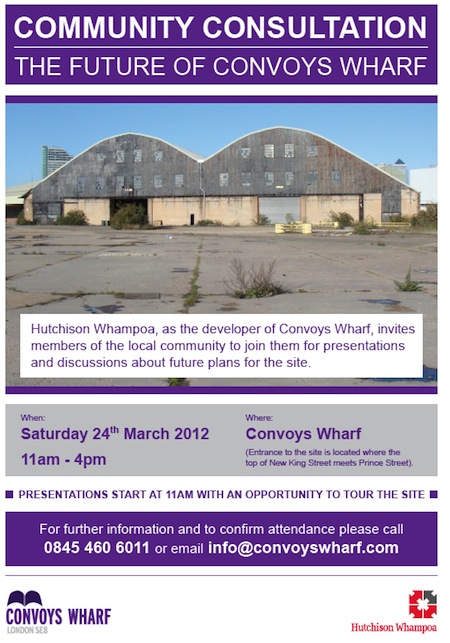
The event is slated as 'presentations and discussions about future plans for the site'.
The poster says that the presenations start at 11am and there will be an opportunity to tour the site. You should meet at the entrance to Convoys Wharf, which is at the top of New King Street.
According to the poster you should email info@convoyswharf.com to confirm attendance, or call 0845 460 6011.
The event is slated as 'presentations and discussions about future plans for the site'.
The poster says that the presenations start at 11am and there will be an opportunity to tour the site. You should meet at the entrance to Convoys Wharf, which is at the top of New King Street.
According to the poster you should email info@convoyswharf.com to confirm attendance, or call 0845 460 6011.
Sunday, 13 November 2011
Have you been consulted?
On major redevelopments such as Convoys Wharf, Lewisham Council recommends that the applicant consult with the local community, although there is no statutory requirement for them to do so. However Hutchison Whampoa clearly believe they have done so, having employed Hard Hat Communications to undertake a 'community engagement programme'. They have produced a 58 page document entitled Statement of Community Involvement which was submitted along with the other planning documents.
The document states: "The engagement and consultation programme was undertaken prior to the submission of the outline planning application, with feedback from residents and community organisations helping to inform the final masterplan."
We wondered what feedback they had received, and how this had been used to inform the final masterplan. The document lists the "Consultation Activity" that took place before the latest application, including meetings and feedback.
Between 14th November 2009 and 29th January 2010, Stakeholder Meetings were held with:
• Ray Hall (local architect) and Helen McIntosh (local PR consultant) focussing on an alternative scheme developed by Ray.
• Bill Ellson (Creekside Forum and Convoys Opportunity), with focus on the permeation of the site by public transport and the levels of S106
• Carol Hynes (CEO Cannon Wharf Business Centre) and Mike Forster (MD Translloyd Developments) discussing potential impact on congestion and ensuring that the site was easily accessible.
• Matthew Couper (Deptford X), discussing what opportunities there might be in utilising the site for community arts before any construction or development work began.
• Malcolm Cadman and David Fleming (Pepys Tenants Action Group), focussing on the size of the towers, the protected wharf, the lack of marine based industry around a cruise liner terminal, potential for flooding, the type of employment onsite, the types of apartments, and the quality of the affordable accommodation.
• Lewis Herlitz, Malcom Cadman and Angelo E Silva (Pepys Community Forum), identifying a number of concerns: the towers’ impact on other buildings in the area, the lack of a cruise liner terminal, transport related issues, affordable housing, open space, wharf uses and Deptford as a visitor destination alongside Greenwich.
• Andrew Carmichael (Creative Process), discussing transport and how the Olympia Warehouse might be used.
• Alan Bailey, John Franklin and Ursula Bowyer (Greenwich Society) and Philip Bins (Greenwich Conservation Society), raising issues around the route of the Thames Path to ensure it continued without break along the frontage of the site, the levels of affordable housing, the amount of family-sized apartments, the impact on local views, the amount of open space, archaeological evaluations, and the design of the towers.
• William Richards and Chris Mazeika (Master Shipwrights House), regarding the location of the safeguarded wharf, layout of the masterplan, transport arrangements and the history and heritage of the site.
• James Aldous and Chris Coode (Thames 21 – an environmental charity working with local communities on riverside programmes)
• Christine and Alison Carey (Chris Carey’s Collections), discussing employment space in the designated working wharf
• Joan Ruddock MP, discussing the revised proposals, the response to the public consultation and future timelines.
There were also two 2-day Public Exhibitions in December 2009 and July 2010 (both attended by less than 150 people). This is the distribution area of leaflets and letters informing local residents of the first exhibition:

And of the second exhibition:

The report states: “In addition to the feedback received from the stakeholder meetings, other members of the local community contributed their views via email through the website or by filling out one of the feedback forms, either at the exhibition or by returning via Freepost when received through their letterboxes…The feedback was mixed, with those who opposed the original News International scheme remaining against the revised proposals. However, there were positive comments and a desire from some to see the development move forward. Overall, as many positive comments were received as negative."
It's interesting to read the detail and find out what the researchers counted as 'positive' comments; in fact many of them were accompanied by a 'but...'. For instance:
“Broadly welcome it, but want more social housing, less car parking spaces..."
"Mostly good…Disappointed that there will be a massive tower block."
"Sounds great for the area but I'm concerned regarding transport...bus routes, car parking..."
"...look forward to seeing how the traffic will be improving in Creek Road because at the moment this road is not wide enough..."
"Would be nice to see something finally made of this area but slightly too built up for my liking. Deptford is already over-populated and dense. Would like to see more communal park land/areas. Transport wise, an extra tube stop would be useful..."
"Looks great. Major concerns about the flow of traffic though...An extra tube stop might be useful."
"Hopefully this will bring better transportation links to the area...and how about a tube line."
"...have you considered re-opening the closed school at Charlotte Turner rather than building a whole new facility?..."
"Glad the site is being redeveloped but...would not want to see a 2-tier Deptford of haves and have nots emerge..."
"I had thought that Lewisham's policy was 50% and not 25% of the scheme is likely to be affordable."
We strongly disagree with the decision of the researchers to count these as 'positive' comments, with many of them raising the same concerns as the 'negative' comments. Many simply preface their negative comments with a statement that they broadly welcome redevelopment of the site. 'Negative' statements included:
“How much housing is for the locals? Has any thought been given to schools or transport?"
"No need for tower blocks. Not enough sense and understanding of the history of the area."
"Towers in the granted outline permission are a serious concern...two or three times the height of any tower blocks in the vicinity (which are in themselves atypical)..."
"Too high"
"Transport is an issue...particularly in terms of increased amount of parking spaces/car traffic."
There were also complaints that consultation hadn't been well enough publicised and demands for more green space.
One comment noted that other Hutchison Whampoa developments "are hugely exclusive schemes that have been dropped in on local communities oblivous to the local culture and zeitgeist rather than evolved with them organically."
Others said:
"...a private development will not benefit the local area...There will be a massive increase in population and not enough infrastructure to deal with the influx."
"... The heights of the tower blocks will overshadow local residents..."
"Still concerns regarding local infrastructure, local transport under stress already, traffic congestion will become worse, very little benefit to local community."
"The proposed will bring a huge increase in road traffic which will further harm our air quality which is already responsible for over 150 deaths each year in this ward. A 75% proportion of private housing is unconscionable in a housing crisis in a borough with thousands of homeless families. The extremely high density proposed will alter the whole character of the area. This proposal will enrich developers and housing speculators at the expense of local people. The lack of any environmentally sustainable aspects – solar power, wind turbines, local water treatment etc should not be permitted in the 21st century. This shows a complete lack of strategic planning if approved by the council."
Overall there is very little in this document that commends the present masterplan and none of the points made were taken on board by the developers or incorporated into the amended plans.
Whilst it is clear the level of consultation has been minimal, it's also clear that there is no point at all to any public consultation if the views gathered are disregarded. The answer is simple: this is not consultation, it is a PR exercise designed to ease locals into changes that may not benefit them by giving them the illusion that their views count.
“Public participation in the planning process was and continues to be a subtle form of social control, which proliferates the notion that participants have power over decision-making processes.” Daniel Lobo, Report for Planners on the Urban Politics of Deptford Regeneration, 2011, Bartlett School of Planning, University College London
The document states: "The engagement and consultation programme was undertaken prior to the submission of the outline planning application, with feedback from residents and community organisations helping to inform the final masterplan."
We wondered what feedback they had received, and how this had been used to inform the final masterplan. The document lists the "Consultation Activity" that took place before the latest application, including meetings and feedback.
Between 14th November 2009 and 29th January 2010, Stakeholder Meetings were held with:
• Ray Hall (local architect) and Helen McIntosh (local PR consultant) focussing on an alternative scheme developed by Ray.
• Bill Ellson (Creekside Forum and Convoys Opportunity), with focus on the permeation of the site by public transport and the levels of S106
• Carol Hynes (CEO Cannon Wharf Business Centre) and Mike Forster (MD Translloyd Developments) discussing potential impact on congestion and ensuring that the site was easily accessible.
• Matthew Couper (Deptford X), discussing what opportunities there might be in utilising the site for community arts before any construction or development work began.
• Malcolm Cadman and David Fleming (Pepys Tenants Action Group), focussing on the size of the towers, the protected wharf, the lack of marine based industry around a cruise liner terminal, potential for flooding, the type of employment onsite, the types of apartments, and the quality of the affordable accommodation.
• Lewis Herlitz, Malcom Cadman and Angelo E Silva (Pepys Community Forum), identifying a number of concerns: the towers’ impact on other buildings in the area, the lack of a cruise liner terminal, transport related issues, affordable housing, open space, wharf uses and Deptford as a visitor destination alongside Greenwich.
• Andrew Carmichael (Creative Process), discussing transport and how the Olympia Warehouse might be used.
• Alan Bailey, John Franklin and Ursula Bowyer (Greenwich Society) and Philip Bins (Greenwich Conservation Society), raising issues around the route of the Thames Path to ensure it continued without break along the frontage of the site, the levels of affordable housing, the amount of family-sized apartments, the impact on local views, the amount of open space, archaeological evaluations, and the design of the towers.
• William Richards and Chris Mazeika (Master Shipwrights House), regarding the location of the safeguarded wharf, layout of the masterplan, transport arrangements and the history and heritage of the site.
• James Aldous and Chris Coode (Thames 21 – an environmental charity working with local communities on riverside programmes)
• Christine and Alison Carey (Chris Carey’s Collections), discussing employment space in the designated working wharf
• Joan Ruddock MP, discussing the revised proposals, the response to the public consultation and future timelines.
There were also two 2-day Public Exhibitions in December 2009 and July 2010 (both attended by less than 150 people). This is the distribution area of leaflets and letters informing local residents of the first exhibition:

And of the second exhibition:

The report states: “In addition to the feedback received from the stakeholder meetings, other members of the local community contributed their views via email through the website or by filling out one of the feedback forms, either at the exhibition or by returning via Freepost when received through their letterboxes…The feedback was mixed, with those who opposed the original News International scheme remaining against the revised proposals. However, there were positive comments and a desire from some to see the development move forward. Overall, as many positive comments were received as negative."
It's interesting to read the detail and find out what the researchers counted as 'positive' comments; in fact many of them were accompanied by a 'but...'. For instance:
“Broadly welcome it, but want more social housing, less car parking spaces..."
"Mostly good…Disappointed that there will be a massive tower block."
"Sounds great for the area but I'm concerned regarding transport...bus routes, car parking..."
"...look forward to seeing how the traffic will be improving in Creek Road because at the moment this road is not wide enough..."
"Would be nice to see something finally made of this area but slightly too built up for my liking. Deptford is already over-populated and dense. Would like to see more communal park land/areas. Transport wise, an extra tube stop would be useful..."
"Looks great. Major concerns about the flow of traffic though...An extra tube stop might be useful."
"Hopefully this will bring better transportation links to the area...and how about a tube line."
"...have you considered re-opening the closed school at Charlotte Turner rather than building a whole new facility?..."
"Glad the site is being redeveloped but...would not want to see a 2-tier Deptford of haves and have nots emerge..."
"I had thought that Lewisham's policy was 50% and not 25% of the scheme is likely to be affordable."
We strongly disagree with the decision of the researchers to count these as 'positive' comments, with many of them raising the same concerns as the 'negative' comments. Many simply preface their negative comments with a statement that they broadly welcome redevelopment of the site. 'Negative' statements included:
“How much housing is for the locals? Has any thought been given to schools or transport?"
"No need for tower blocks. Not enough sense and understanding of the history of the area."
"Towers in the granted outline permission are a serious concern...two or three times the height of any tower blocks in the vicinity (which are in themselves atypical)..."
"Too high"
"Transport is an issue...particularly in terms of increased amount of parking spaces/car traffic."
There were also complaints that consultation hadn't been well enough publicised and demands for more green space.
One comment noted that other Hutchison Whampoa developments "are hugely exclusive schemes that have been dropped in on local communities oblivous to the local culture and zeitgeist rather than evolved with them organically."
Others said:
"...a private development will not benefit the local area...There will be a massive increase in population and not enough infrastructure to deal with the influx."
"... The heights of the tower blocks will overshadow local residents..."
"Still concerns regarding local infrastructure, local transport under stress already, traffic congestion will become worse, very little benefit to local community."
"The proposed will bring a huge increase in road traffic which will further harm our air quality which is already responsible for over 150 deaths each year in this ward. A 75% proportion of private housing is unconscionable in a housing crisis in a borough with thousands of homeless families. The extremely high density proposed will alter the whole character of the area. This proposal will enrich developers and housing speculators at the expense of local people. The lack of any environmentally sustainable aspects – solar power, wind turbines, local water treatment etc should not be permitted in the 21st century. This shows a complete lack of strategic planning if approved by the council."
Overall there is very little in this document that commends the present masterplan and none of the points made were taken on board by the developers or incorporated into the amended plans.
Whilst it is clear the level of consultation has been minimal, it's also clear that there is no point at all to any public consultation if the views gathered are disregarded. The answer is simple: this is not consultation, it is a PR exercise designed to ease locals into changes that may not benefit them by giving them the illusion that their views count.
“Public participation in the planning process was and continues to be a subtle form of social control, which proliferates the notion that participants have power over decision-making processes.” Daniel Lobo, Report for Planners on the Urban Politics of Deptford Regeneration, 2011, Bartlett School of Planning, University College London
Tuesday, 18 October 2011
Where are our councillors?

At the Drop-In at St Nicholas' Church last Tuesday 11th October, members of the public mingled with Lewisham's planning team headed by Emma Talbot, along with architects from Aedas, senior project managers from Hutchison Whampoa and other partners in the Convoys Wharf development team (BPTW, HardHat and Buro Happold), plus Duncan Hawkins, supervisor of the archaeological work being undertaken by the Museum of London. Drawings and plans were laid out on tables but no model of the site was available.
One attendee wrote to Deptford Is...
"It was hard for the locals to know who anyone was since no one was wearing a label to identify themselves. I found myself talking to Hutchison Whampoa Senior Project Manager Phil Haden (I had to ask) who was very keen to stress how wonderful the river park would be, and who dismissed the recent three-day, three-mile radius traffic gridlock after a small fire on Deptford Broadway as the fault of the emergency services (and therefore not of major consideration in the scheme's transport provision). He was also amused that Lewisham wanted a new school when Greenwich had just closed one down nearby. Much of the time I had to stand behind a huddle of people who were arguing about the lack of provision for young people, the paltriness of the public open space, and the details of the archaeological dig. Questions asked tended not to get straight answers, whilst answers were given to questions not even asked. The architects themselves seemed not to know their own drawings and Hawkins, the archaeologist, defended his position fiercely despite gaping holes (pun intended) in his arguments."
Most obviously missing from those in attendance were our local councillors – in particular, those from Evelyn Ward, who although not in a position to vote on the proposals, would be given time to speak on their constituents' behalf. Before the meeting we wrote to Cllrs Joseph Folorunso, Crada Onuegbu and Sam Owolabi-Oluyole asking them to come to the Drop-In. Not one replied – Cllr Folorunso's email box was so full, our request bounced back.
From New Cross Ward, we got replies from Cllr Madeliene Long who apologised that she already had another meeting. Cllr Maslin (who is on the Strategic Planning Committee gifted with the powers to pass the proposals) responded that he did not know about the Drop-in and had domestic commitments but would talk to Head of Planning to take up the points we had made. He later wrote to assure us that local concerns were being taken very seriously by the Head of Planning. Cllr Padmore did not reply.
According to the New Cross councillors, only Evelyn Ward were notified of the Drop-In, yet none saw fit to attend. This ill serves the democratic process that is meant to be part of an application of this magnitude. Our elected representatives are supposed to be our first line of defence. It is particularly worrying that one of these councillors attends their mailbox so infrequently that it will not accept any more emails.
We also wrote to Joan Ruddock who responded promptly to say she was going into hospital. She did not send any representatives however, but her assistant has since written to say Joan has asked to meet with Lewisham planning officers about our concerns. Cllr Onuegbu also got in touch after the Drop-In to apologise and agree to a meeting with objectors (yet to be arranged).
On the Convoys Wharf website, under Next Steps, it is stated that statutory public consultation has begun and will run until mid-December. A Drop-In of the kind organised last week where no one wore a name badge and conversations took place in small clusters cannot be considered 'public consultation'. We will therefore be requesting a Public Meeting, where the questions asked and the answers given can be heard by all.
Subscribe to:
Posts (Atom)